
Expanding How We Understand Customer Behavior from Funnels to Journeys
- Jason Lucey
- Mar 16
- 5 min read

This article was originally published on LinkedIn in November 2025: https://www.linkedin.com/pulse/expanding-how-we-understand-customer-behavior-from-funnels-lucey-odxrc
Funnels are familiar, practical, and deeply embedded in how marketing teams think. They present a clean, structured story: start with a wide top, narrow steadily, and arrive at a final conversion point. That logic is comforting. It's easy to understand. It suggests predictability — a steady pace of narrowing until only the most qualified or committed person emerges at the bottom.
This is a useful mental model in the right context, such as task-based workflows — app signups, checkout flows, lead forms. It shows us which steps are working and which aren’t. It tells us where the process stalls. It tells us where to optimize.
When Real Life Doesn’t Look Like a Funnel

When we lift our gaze from a single workflow and try to understand how people actually come to a decision on something, the funnel gets confusing. People rarely behave like tidy geometric shapes. In reality, customer behavior is full of legitimate exceptions:
Users restart journeys because they forgot a password.
Prospects disappear because their budget cycle changed.
People commit fraud and can give false answers
People share accounts
Enterprise buyers pull in additional approvers who each need their own time.
Influencers and stakeholders have different motivations and mindsets entirely.
Some people convert early, others late, others only after a completely unrelated event.
A funnel doesn’t treat these behaviors as normal. It treats them as problems. This leads to teams adding more tracking, more rules, more data capture, and more technical overhead to catch every exception. This can create brittle attribution systems and privacy liabilities that are increasingly hard to justify.
The reality is that funnels want to be tubes — perfectly efficient pipelines with zero attrition. But pipelines only work in highly deterministic systems where behavior is completely stable. Customer decision-making is not like this.
Journeys Are A More Human, More Flexible Model
Journeys, by contrast, begin with a simple observation: people don’t move in straight lines. They move in states of mind. Contemporary marketing, behavioral science, CX, and decision-science literature, in the last decade, has started shifting away from rigid funnel thinking toward more flexible, nonlinear models. This is well supported by a wide variety of industry research, such as Google's "Messy Middle" and McKinsey's "Customer Decision Journey".
You can be wondering, exploring, comparing, distracted, pausing, urgently needing, or revisiting — and you can shift between these states repeatedly, sometimes within the same afternoon. Life interrupts the linear march that funnels assume. Journeys embrace this.

Where funnels focus on minimizing attrition, journeys focus on maximizing relevance. Instead of asking “How do we push people further down?”, journeys ask “What is this person thinking or feeling right now? And how does our message align with that?” In this way, journey strategy may take into consideration a wide variety of factors:
Deep, personal resonance with someone’s values and aspirations
Momentary, situational resonance with their current mindset and decision-making state
All of this is designed to resonate more across more mindsets. This is a very different philosophical approach that funnel thinking.
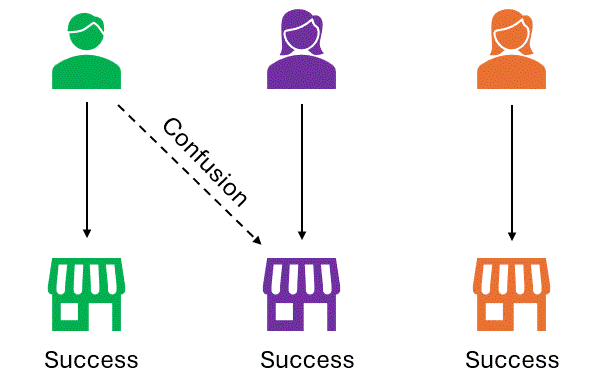
Importantly, in a journey model, a person can convert from almost any mindset:
If they’re casually curious and something truly resonates, they can act sooner or later.
If they’re comparing options and you satisfy the criteria they care about, they can act very soon.
If they face an urgent need, they may act on the spot.
Conversion is not reserved for “the bottom.” Conversion is supported by resonating and aligning with the customer at any stage of the decision-making process.
This makes journeys far better suited to complex ecosystems — enterprise sales, multi-stakeholder decisions, B2B procurement, or any environment where the buyer isn’t the user and decisions unfold across multiple people, weeks, and contexts. Funnels struggle here because they compress everything into a single linear path. Journeys thrive because they accommodate the richness and variability of real decision-making.
Journeys Need Data Too
One risk of journey thinking is that it can drift into something overly philosophical — or worse, become locked into static personas that were created months or years earlier and never evolved. Personas and empathy maps are useful starting points, but without ongoing measurement, they quickly become outdated stories rather than living representations of how people actually think and behave.
Journeys need feedback loops just as much as funnels do. If anything, they need them more. Because journeys are nonlinear and mindset-driven, the only way to understand what’s truly resonating — and when it is resonating — is to observe patterns over time. You can't know what “right message, right place, right time” means unless you can measure when different messages align with different states of mind. You need data not to understand where and how relevance emerges.
This is where many journey frameworks fall short. They rely on questionable workshops, "HIPPO" scenarios, and institutional folklore. But they rarely include a systematic way to validate whether a message actually had impact, whether it reached a given mindset, or whether that mindset even existed in the first place. As I wrote in my previous article on the shortcomings of linear attribution, measurement systems that reduce everything to an omni-purpose revenue number can’t accurately represent the value and subtleties of real journey behavior.
Instead, journeys need a form of measurement that can recognize patterns across time, detect delayed influence, and quantify resonance. They need impact scores that show relationships, momentum, and emerging signals. This data feedback loop is critical, otherwise journey-based strategies risk becoming beautifully articulated but operationally blind. Journeys need data too — just not the same data funnels rely on.
Where Funnels Excel, Where Journeys Excel
This is not to say that funnels are not important. They certainly have their uses. However, in my experience, most modern marketing strategy relies too much on this model to their own detriment. Consequently, optimization efforts are hindered and performance is impacted.
Where do Funnels excel?
Diagnosing friction in step-based workflows
Optimizing discrete tasks
Making sequential processes more efficient
Revealing where technical or UI issues create confusion or misdirection
Where do Journeys provide better guidance?
Capturing nonlinear decision-making
Accounting for backtracking, pauses, and multiple actors in complex sales processes
Surfacing relevance gaps beyond friction points
Aligning messaging with evolving mindsets
Recognizing the importance of early stage thinking on bottom line impact
Understanding how people actually think over time
Neither model is “right” or “wrong.” They elicit different questions, and they provide different perspectives. In my experience, funnels are great for discrete process optimization. Journeys are much better for understanding decision-making.
Why This Shift Matters
Modern marketing increasingly demands that we understand more than the last click or the final step. Modern marketing is also increasingly expected to deliver reliable business impact. The most frequent answer to this is to lay on more tech, more AI, and more invasive tracking systems. This is what the big providers are selling. However, these answers are increasingly invasive, increasingly technically fragile, and increasingly out of step with what consumers are comfortable with.
It is true that journey thinking has been around for a long time and much has already been written about them. But funnel thinking seems as universally embedded as ever in modern marketing strategy, and I would suggest that this is a detriment to the industry practitioners and the clients who hire them.
While funnels will always remain useful, journeys give us something we’ve long been missing — a more honest, more human model of how decisions actually happen for each person in their own time. Understanding how people make decisions and when marketing is resonating in messy, non-linear scenarios is more important than ever. Journey-based thinking is simply the stronger approach for this task.